Monday, November 6, 2023

Preliminary Exercise 12: Camera Movement Videos


          The objective of this assignment is to use a storyboard to select camera movement frames and create videos to demonstrate camera movement techniques in film. To complete this assignment, I needed to find people to play the role of the storyboard and a tripod to create a certain effect of some of the camera movements. The camera movement techniques I selected to recreate in the videos are zoom-in shot, Dolly shot, static shot, push-in shot, tilt, dolly push-in, Pan, and tracking. The zoom-in shot focuses on the subject and creates suspense on what will be or was the outcome of the subject. The dolly shot is to follow the forward movement of the subject to show the status it has on everybody else. The static shot centers the focus on the conflict without too much movement being taken place at the same. The push-in shot gets a closer look at the reaction of the subject. The tilt shot reveals the subjects and the scheme they're planning. The dolly push-in shot gets a closer look at the information that is being shown. The pan shot shows how the subject is affecting its surroundings (causing it to shake). The tracking shot follows the subject to show the consequence of their action.

Video #1
Zoom in shot


Action Line: Lexi is shown lying on the theatre stairs.
Shot Size: Establishing shot
Camera Angle: High angle
Framing: One shot
Composition: Horizontal lines
Tone: Unsettling

Video #2
Dolly Push-in Shot


Action Line: Lexi and her friend are shown walking down the hallway of their school. The students around them are distracted by their phones.
Shot Size: Full shot
Camera Angle: Shoulder level
Framing: Crowd shot
Composition: Leading lines
Tone: Casual

Video #3
Static Shot


Action Line: Lexi and her friend bully a student.
Shot Size: Master shot
Camera Angle: Shoulder level
Framing: Three shot
Composition: Shallow focus
Tone: Menacing

Video #4
Push in Shot


Action Line: The student bullied by Lexi and her friend appears shaken and frozen in fear.
Shot Size: Medium close-up shot
Camera Angle: Eye level
Framing: Single shot
Composition: Deep focus
Tone: Horrified

Video #5
Dolly in Shot


Action Line: A blurry flashback of a contract stating that Piper High School is a cult and that the school covered Lexi's death, appears on the screen, which then creates situational irony.
Shot Size: Medium shot
Camera Angle: Dutch angle
Framing: Insert shot
Composition: Shallow focus
Tone: Shocking

Video #6
Pan shot


Action Line: After a student at Piper High School discovers their school's contract and the truth behind their peer's death, the student decides to reveal the truth about their school. The intercom blazes in every classroom and hallway. This scene shows two students at Piper High School briefly taking notice of the announcement but eventually continuing about their days.
Shot Size: Extreme close-up
Camera Angle: Dutch and cowboy shot
Framing: Insert shot
Composition: Deep focus
Tone: Hopeful

Video #7
Tracking Shot


Action Line: The student who exposed the truth about her school on the intercom gets interrupted in the middle of her announcement. She gets escorted by the school's security.
Shot Size: Medium shot
Camera Angle: Knee level
Framing: Over-the-shoulder shot
Composition: Color
Tone: Weary

Reflection

          In this exercise, I learned how to execute these camera movements in film and how to use them effectively. Each team member took turns filming a camera movement and taking part in the film. We also also assisted in gaining people to join in the film. Me and my teammates worked with the resources by getting into the character of the films and pretending it is in real life. I feel we did very well on this assignment, but there can always be room for improvement.


Work Cited

Zoom Definition & Meaning | Britannica Dictionary. (n.d.). https://www.britannica.com/dictionary/zoom#:~:text=zoom%20in,to%20be%20bigger%20and%20closer

Kench, S. (2023, September 1). What is a Static Shot? Definition and Examples in Film. StudioBinder. https://www.studiobinder.com/blog/what-is-a-static-shot-definition/#:~:text=A%20static%20shot%20in%20film%20is%20a%20shot%20that%20is,move%20in%20a%20static%20shot

What is a Tilt Shot? Essentials of Tilt Camera Movement. (2020, October 5). StudioBinder. https://www.studiobinder.com/blog/tilt-shot-in-film/#:~:text=A%20tilt%20shot%20is%20shot,raising%20or%20lowering%20their%20heads


Wednesday, November 1, 2023

Preliminary Exercise 11: Camera Movement Storyboard


          The objective of this assignment is to use PowerPoint to construct an organizer that lists 12 camera movement strategies used in movies, highlights three important aspects for each, and creates an image for each. I illustrated the camera's movement on the storyboard by attempting to draw the movement of the camera on the scene. It is used to get an idea of how the movement may look when filming. To complete this assignment, I researched information on camera movements and what each camera movement looks like so I could have a grasp of knowledge of what movements I could possibly use. In my team of four, I helped research the camera movements along with another one of my teammates, teammate 3 wrote down the script, and Teammate 4 drew the script. We all contributed to planning the script. It is important to create a storyboard because it helps plan and visualize events by providing a structured outline.


Reflection

              In this exercise, I learned how different camera movements can affect a scene in a film by creating more emphasis on a particular feeling, mood, or tone. After creating the storyboard, I and my teammates will actually film the storyboard scenes using camerawork techniques and movements.

Work Cited

V. (2023, January 30). Storyboarding: Methods, techniques, and lingo. Videomaker. https://www.videomaker.com/article/f2/15415-how-to-make-a-storyboard-storyboard-lingo-techniques/#:~:text=By%20visualizing%20your%20shots%20with,wasting%20both%20time%20and%20footage.

Monday, October 23, 2023

Preliminary Exercise 10: Camera Movement Techniques Organizer


          In film, camera movement refers to the way a camera shifts to visually narrate and shape a viewer's perspective of a scene. In the planning of the film, camera movement helps influence mood and perspective, which enhances emotion and storytelling to engage the audience. To capture a shot, a camera can move left or right to make a pan shot, or up and down to make a tilt shot. Camera movement's effect on an audience can evoke specific emotions and can guide their focus to specific details. In this assignment, the goal is to gain knowledge and take note of the different camera movements that can be used in a film.


Reflection

            The objective of this assignment was to research camera movement techniques in film and place the research in an organized PowerPoint with visuals. I became more interested in camera movements when I watched a YouTube video. It was two of the same video but it demonstrated the video with and without camera movement. I realized how much more intrigued I was watching with movement, which led to me doing more research about it. In this activity, the PowerPoint contains the research me and my team did on camera movement. We split the research up so Peyton did the first three, Khloe did 4-6, I did 7-9, and Marley did 10-12. We used icons to create our own illustrations of the movements. We all are pretty familiar with Powerpoint so it was easy to do. During this activity, I learned how to apply camera movements in film to create a certain feeling or a certain focus.

Work Cited

M. (2021, June 26). The Importance of Camera Movement in Video Production. On Point Video Productions. https://onpointvideo.ca/best-practices/the-importance-of-camera-gimbals-and-drones/#:~:text=Camera%20movement%2C%20following%20the%20action,adds%20impact%20to%20key%20scenes

Camera Movement. (n.d.). Studio. https://browardschools.instructuremedia.com/embed/4612ffa3-91a4-42c2-9157-71d57fd7134b

Monday, October 16, 2023

Preliminary Exercise 9: Practicing Camerawork: Shot Sizes, Camera Angles, Framing, and Camera Composition Day 2


           Filming on a site means shooting the actual setting where the story takes place. Cinematography is the art of visual storytelling using motion picture photography. The cinematographer is mainly responsible for this, as well as the camerawork on a film's production. Cinematographer, Don Burgess, was responsible for the camerawork of the iconic movies "Spider-Man" and "The Polar Express." He won an Academy Award, the American Society of Cinematographers, the BAFTA Awards, and many other awards.


Shot #1


Someone getting handed a gift.
Shot Size: Close up
Camera Angle: Overhead shot
Framing: Over-the-shoulder
Composition: Point of view
Tone: Thoughtful

Shot #2


Two friends have a very close stare-down.
Shot Size: Extreme close-up
Camera Angle: Eye level
Framing: Two Shot
Composition: Deep focus
Tone: Intense

Shot #3


A Hello Kitty toy lying on the table.
Shot Size: Medium shot
Camera Angle: Dutch angle
Framing: Insert shot
Composition: Shallow focus
Tone: Wholesome

Shot #4


A person admiring the nature around him.
Shot Size: Medium-full shot
Camera Angle: Shoulder level
Framing: Single shot
Composition: Balance
Tone: Serenity

Shot #5


A Santa Clause statue beside a wall.
Shot Size: Extreme close-up
Camera Angle: Dutch angle
Framing: Insert shot
Composition: Deep focus
Tone: Joyous

Shot #6


Visitors at a museum enjoy their surroundings as they walk around.
Shot Size: Wide shot
Camera Angle: High Angle
Framing: Crowd shot
Composition: Horizontal
Tone: Intriguing

Shot #7


A student attempting to pose for a picture.
Shot Size: Medium shot
Camera Angle: Knee level
Framing: Over-the-shoulder
Composition: Color
Tone: Goofy

Shot #8


A Christmas tree is being displayed in a home.

Shot Size: Medium-full shot
Camera Angle: Ground level
Framing: point of view
Composition: Shallow focus
Tone: Comforting


Reflection

          My team learned camerawork techniques to practice planning short stories and film frames. To make it easier on the second day, me and my team were planning on how were going to take the shots beforehand, so we didn't waste time planning at the locations we were taking the shots at. My team switched roles, filming and acting, so there could be different characters in the shot. We accomplished the goal of continuing the planning of short stories and filming frames. Each team member took turns capturing pictures with different camerawork techniques and taking a part in the story. We used our phones to take the pictures because we had easier access to them and they were easy to use. In this exercise, I learned how to apply these camerawork techniques in real life to take shots that reflect the feeling and the mood of a scene.


Work Cited

Filming On Location: Understanding And Doing It | MarilynFilms.com - Blog. (2018, November 26). https://marilynfilms.com/filming-location-understanding-doing/#:~:text=What%20is%20generally%20meant%20by%20filming%20on%20location,a%20sense%20of%20greater%20realism%20to%20their%20films

Tuesday, October 10, 2023

Preliminary Exercise 8: Practicing Camerawork: Shot Sizes, Camera Angles, Framing, and Camera Composition Day 1


          Camerawork is the way cameras are used in a film using elements like framing, composition, movement, and angles. Camerawork is crucial in film because it strengthens storytelling, establishes the mood, and helps engage the audience by complementing the narrative of a film. When planning the camera shots I considered:

-  Shot size: establishing shot, master shot, wide shot, full shot, medium shot, medium close-up, and medium-full

- Camera angle: dutch angle, high angle, ground level, shoulder level, eye level, and low angle

- Framing: two-shot, point of view, single, and three-shot

- Composition: point, space, deep focus, shallow focus, lines, and balance.

          Shot size is the amount of setting or subject given in a frame (for example: wide shot). Camera angle is the specific location where a camera is placed (for example: eye level). Framing is the placement and positing of subjects in a shot (for example: two shot). Composition is the way elements of a scene are arranged in a camera frame (for example: deep focus). The cinematographer is responsible for camerawork in film production. Matthew Libatique is the cinematographer for "Iron Man" and "Birds of Prey." He has been recognized in Academy Awards, the American Society of Cinematography, the Boston Society of Film Critics Awards, and many others. Me and my teammates have to develop camerawork skills to create our film because they are essential for storytelling and influencing the mood and atmosphere to enhance the narrative.


Shot #1

A figure hiding in the shadows.

Shot Size: Establish shot
Camera angle: high angle
Framing: one shot
Composition: depth of feel
Tone: Unsettling

Shot #2


A student walking to class.
Shot Size: master shot
Camera angle: shoulder level
Framing: crowd shot
Composition: leading lines
Tone: Casual

Shot #3


Fans are early to a game, waiting for it to start.
Shot Size: wide shot
Camera angle: high angle
Framing: crowd shot
Composition: leading lines
Tone: calm

Shot #4


Students evacuate their building.
Shot Size: full shot
Camera angle: shoulder level
Framing: crowd shot
Composition: shallow focus
Tone: anxious

Shot #5


Cheerleaders practicing before a game.
Shot Size: master shot
Camera angle: shoulder level
Framing: three shot
Composition: Balance
Tone: Focused

Shot #6


A masked person challenging somebody.
Shot Size: medium shot
Camera angle: high level
Framing: single shot
Composition: color
Tone: Daring

Shot #7


A person looking at the aquatic life.
Shot Size: medium shot
Camera angle: close-up
Framing: single shot
Composition: depth of feel
Tone: Intriguing

Shot #8


Two students focusing on their camera.
Shot Size: medium-full shot
Camera angle: low angle
Framing: two shot
Composition: Balance
Tone: goofy


Reflection

          My team created a suspenseful school mystery that involves the death of a student on school grounds. It was a little difficult to achieve because we had to create a story that included all the camerawork techniques in the picture. We accomplished the goal of learning camerawork techniques and practicing planning short stories and film frames. Each team member took turns capturing pictures with different camerawork techniques and taking a part in the story. We also assisted in gaining people to join in the shots. Me and my teammates worked with the resources by getting into the character of the shots and pretending it was in real life. We used our phones to take the pictures because we had easier access to them and they were easy to use. In this exercise, I learned how to apply these camerawork techniques in real life to take shots that reflect the feeling and the mood of a scene.

Work Cited

camerawork. (2023, December 20). https://dictionary.cambridge.org/us/dictionary/english/camerawork

camerawork. (2023, December 20). https://dictionary.cambridge.org/us/dictionary/english/camerawork

Lannom, S. (2023, September 7). Camera Angles Explained: The Different Types of Camera Shot Angles in Film. StudioBinder. https://www.studiobinder.com/blog/types-of-camera-shot-angles-in-film/

Thursday, October 5, 2023

Preliminary Exercise 7: Storyboarding Camerawork: Shot Sizes, Camera angles, Framing and Camera Composition Post 1: Day 2


           In the storyboarding process, I need to outline key moments in the scene and include the dialogue, the action, and camera angles using simple sketches to visualize what is taking place. To create a storyboard, you need the skills of storytelling, creativity, and adaptability. The objective of sheets 3 and 4 is to use camerawork techniques to create storyboard scenes. The camerawork techniques that are used in sheets 3 and 4 are:

Shot size

- Close-up shot

- Extreme close-up shot

- Medium shot

- Medium-full shot

- Wide shot

Camera Angle

- Overhead shot

- Eye level

- Dutch angle

- Shoulder level

- High angle

- Knee level

- Ground level

Framing

- Over the shoulder

- Two shot

- Insert shot

- Single shot

- Crowd shot

- Point of view

Composition

- Point of view

- Deep focus

- Shallow focus

- Balance

- Horizontal line

- Color


Reflection

          The objective of this activity is to use a storyboard, organize shots, and define ideas before putting them into production by analyzing camerawork, shot size, angles, framing, and composition. During day 2 of storyboarding, I learned more camerawork techniques that can be used to create more depth in a scene. It was a little more difficult than day 1 because on day 2 I attempted to incorporate more challenging and lesser-known camerawork techniques. We accomplished the goal of recognizing how audience reactions, media language, and the production, distribution, and consumption processes of the media industry shape the opinions and ideologies expressed in media products. My team prepared for this exercise by researching and gaining more knowledge on camerawork techniques. I worked with 3 other people. Me and Marley took turns drawing, Peyton and Khloe researched together, and we all brainstormed and planned on how to combine the techniques. During this exercise, I learned more ways in which camerawork techniques are used together can greatly influence the sense of the feel of the movie.


Work Cited

Eisner, A. (2023, August 28). Storyboarding: What Makes a Perfect Storyboard? Careers in Film | Film Schools & Colleges. https://www.careersinfilm.com/storyboarding/#:~:text=The%20storyboarding%20process%20involves%20the,be%20clearly%20visualized%20and%20understood

Monday, October 2, 2023

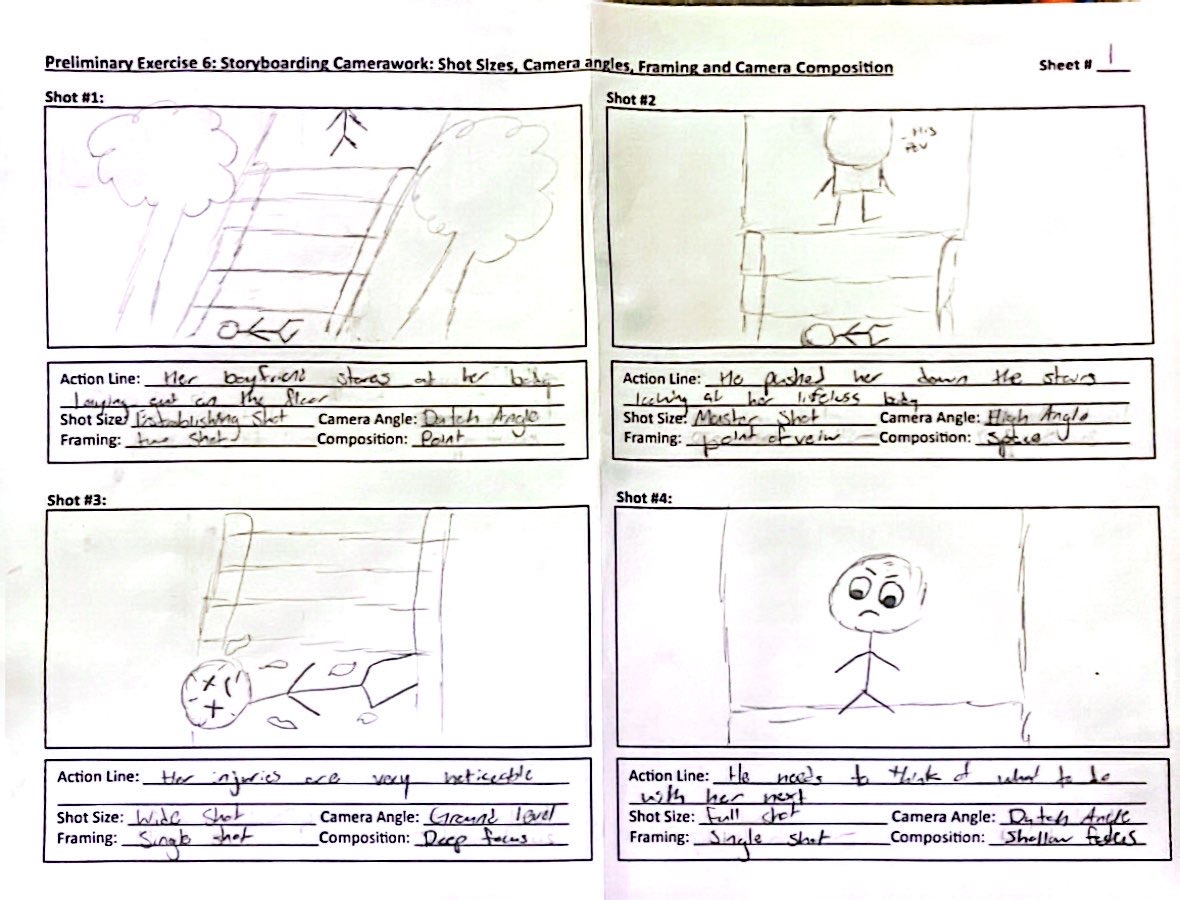
Preliminary Exercise 6: Storyboarding Camerawork: Shot Sizes, Camera angles, Framing and Camera Composition Post 1: Day 1


          The film industry uses storyboards in the planning of movies to set a blueprint for scenes and to visualize a scene in a movie. Film production is the process by which a motion picture is produced. I produced a storyboard with 16 shots (I will show 8 shots today and the other 8 shots tomorrow) demonstrating camera work in scenes. Camerawork is how cameras are used in a film including filming techniques such as shot size, camera angles, camera framing, and camera composition. It is important for students directing films to understand the importance of those techniques because they emphasize the film's storytelling, emotion, and audience engagement. In the first two storyboards, I used the camerawork techniques: 

Shot sizes

- Establishing shot

- Master shot

- Wide shot

- Full shot

- Medium shot

- Medium close-up

- Medium-full

Camera angles

- Dutch angle

- High angle

- Ground level

- Shoulder level

- Eye level

- Low angle

Framing

- Two shot

- Point of view

- Single

- Three shot

Composition

- Point

- Space

- Deep focus

- Shallow focus

- Lines

- Balance


Reflection

          The objective of this activity is to use a storyboard, organize shots, and define ideas before putting them into production by analyzing camerawork, shot size, angles, framing, and composition. In the process of this activity, I learned that the basic concept of storyboards is used by film production to organize a scene in a film. I created a storyboard to show how different camerawork techniques are used and cooperate to create a certain feeling in a scene. The goal of this exercise is to recognize how audience reactions, media language, and the production, distribution, and consumption processes of the media industry shape the opinions and ideologies expressed in media products. My team prepared for this exercise by researching and gaining more knowledge on camerawork techniques. On day 1 of planning the storyboards, we researched camerawork and we all thought of how we could put the techniques together to create a certain feeling. I worked with 3 other people. Me and Khloe took turns drawing, Peyton and Marley researched together, and we all brainstormed and planned on how to combine the techniques. During this exercise, I learned that the way camerawork techniques are used together can greatly influence the sense of feel of the movie.


Work Cited

Spectrum, C. (n.d.). Storyboard Artist Job Description, Salary, Skills & Software. https://www.cgspectrum.com/career-pathways/storyboard-artist#:~:text=Storyboard%20artists%20need%20to%20be,skills%20as%20a%20storyboard%20artist

Critical Reflection: Through Her Eyes

Here is my critical reflection of my group's opening film. It goes into detail of the film and gives explanations of the elements that a...